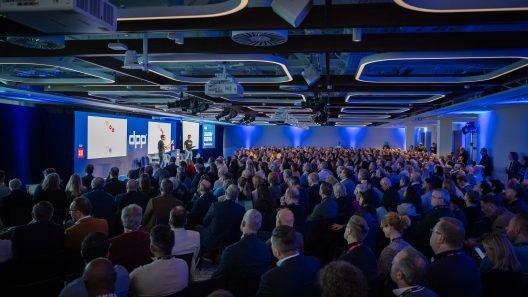
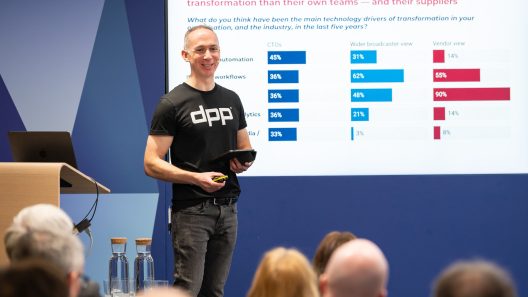

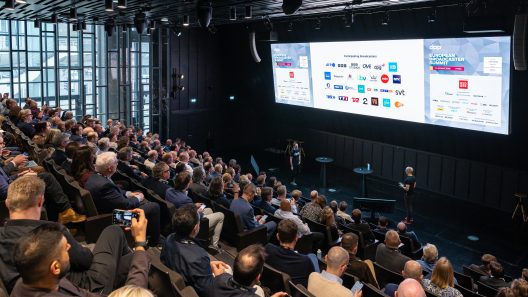




IBC has a frenetic start, with busy halls and visible excitement after a quiet NAB. But it was unable to sustain that pace, and the show lost some momentum as it entered the weekend. Footfall came in waves, with quieter periods each day and a clear distinction between stands that remained busy and those that noticeably weren’t.
Call Out: Quieter doesn’t always mean less valuable
Yet despite the angst expressed on social media, does quieter necessarily mean less valuable? Many vendors claim to have had full diaries, even though passing traffic on their stands was light. But one contributor reduced their team at the last minute in response to lower demand.

Customers do not appear to have lost faith in trade shows either. Preliminary findings from the DPP Media CTO Survey 2026 indicate that around two-thirds of CTOs consider large trade shows at least moderately effective, and continue to see reasons to attend. This is particularly striking amid reports of corporate travel cuts, and some contributors even having to pay their own way to attend. Others had actively sponsored or participated in initiatives such as the IBC Accelerators to strengthen the business case for attending.
The trade shows are transforming rather than disappearing. There is still value, but where attendees find it and how they access it is changing.
Counting the crowd
IBC reported 41,225 attendees in 2026. This was down 6% from 2025 and 8.6% from its post-pandemic high of 45,085.
Attendance at IBC, NAB, ISE and InfoComm - 2017 to 2026

NAB 2026 is displayed with both an organiser-reported registered attendance figure, and a 3rd party audited verified attendance figure. Earlier organiser-reported NAB figures shown are therefore not directly comparable with the 2026 audited figure.
NAB provides the clearest example of why headline attendance statistics need to be treated with caution. Immediately after the 2026 show, NAB announced a headline figure of over 58,000 registered attendees, up from around 55,000 in 2025. In the summer, it then published a third-party audited number of verified attendees, which was 18,000 lower.
Call Out: NAB’s audited attendance tells a very different story from its headline statistics
The difference helps explain why almost everyone we spoke to described the Las Vegas Convention Center as noticeably quieter than the original registration numbers suggested. NAB says it will now use audited minimum figures in marketing;a notable shift at a time when technology companies are focused on the quality of floor traffic and the commercial return from exhibiting.

As highlighted in our NAB 2026 Demand vs Supply report, comparisons between events are difficult because each calculates its metrics slightly differently. They are useful indicators of direction, but should not be treated as directly comparable measures of people physically present on the show floor.
Qualitative feedback is also useful. Both exhibitors and attendees ask themselves: who was there, could I get time with them, and did the right conversations take place?
The ISE Exception
IBC, NAB and InfoComm remain substantial events, but none is achieving sustained growth.
ISE is the outlier, having moved beyond post-pandemic recovery into a new growth phase. Attendance reached 92,170 visitors this year, the second year it exceeded its 2019 total.
Call Out: ISE is significantly larger than it was in 2019 and continues to grow
It is tempting to attribute that success simply to the relative health of Pro AV, but InfoComm serves much of the same market without experiencing comparable growth. Rather than defending the boundaries of an established industry, ISE has benefited from widening them to bring together enterprise AV, live events, digital signage, education, broadcast, and content creation around an increasingly shared set of technologies and challenges.
Crucially, that breadth is bringing new people into the event rather than simply replacing those who no longer attend. Almost 29,500 visitors in 2026 were attending ISE for the first time, representing nearly one third of its audience, while total attendance continued to rise. That is a very different dynamic from NAB, where the audited attendance figure shows an overall audience that is contracting despite successful efforts to attract new communities. ISE is not simply renewing its audience; it is expanding it.
In the DPP’s upcoming Media Tech CEO Survey 2026, more than 46% of respondents said that the effectiveness of traditional large-scale broadcast and media technology trade shows was either diminishing or had largely disappeared.
To what extent do the traditional large-scale broadcast and media technology trade shows meet your organisation's marketing and sales objectives?

DPP Media Tech CEO Survey 2026
And apathy is reflected in trade show exhibitor numbers.
Exhibitors at IBC, NAB, ISE and InfoComm - 2017 to 2026

IBC’s exhibitor numbers are broadly unchanged from 2025. NAB and InfoComm numbers have also remained flat or below recent peaks. Again, ISE is the outlier, with continuous exhibitor growth since 2022.
Call Out: Roughly one in five exhibitors was new to IBC in 2026
The composition of the exhibitor base makes the picture more interesting. In its post show press release, IBC specifically highlighted that 256 companies made their debut in 2026, an increase of 36% from 2025. That means roughly one in five exhibitors was new to IBC.
New and Returning Exhibitors at IBC, NAB, ISE and InfoComm - 2025 and 2026

Since IBC's total exhibitor population barely changed in 2026, the rise in new exhibitors suggests greater turnover within the exhibitor base rather than net expansion.
Call Out: IBC is renewing its exhibitor population, not growing it
ISE is the only show managing to do both: attracting substantial numbers of new companies while increasing the overall size of its exhibition.
This is also where the growing overlap between broadcast and Pro AV becomes significant. In the DPP Media Tech CEO Survey 2025, 39% of respondents identified expansion into new verticals as a strategic priority, with Pro AV and enterprise markets particularly prominent.
What are your top strategic priorities for the next 1-2 years

DPP Media Tech CEO Survey 2025
Some of ISE's growth may therefore be from companies that previously thought of themselves primarily as broadcast or media technology vendors – a hypothesis backed up in the DPP’s conversations with vendors.
From marketplace to meeting place
Before video conferencing, physically bringing the industry together was the most convenient way for vendors to provide demonstrations and for customers to discover the latest technology. This is no longer the case, as customers and vendors now remain connected throughout the year. Yet many of the trade shows still treat themselves primarily as marketplaces.

Photo: James Dade
Halls filled mostly with software demos are no longer enough to justify four days of travel, hotels, and lost working time. Yet, both customers and vendors tell us that bringing the industry together still has value.
Trade shows need to focus on what cannot be reproduced online: face to face meetings, unexpected introductions, and the chance to see the whole industry in microcosm.
Call out: Trade shows must be meeting, learning and intelligence environments
This role of the trade show is no longer a one-stop marketplace; it must be a meeting, learning, and intelligence environment. IBC appears to recognise this through its expanded Future Tech programme and structured networking initiatives. NAB has dedicated networking lounges and its Creator Lab and Sports Summit.
ISE features more physical products which do benefit from in-person viewing: LED walls, audio systems, lighting, and immersive installations. But spectacle alone doesn’t fully explain its continued growth. It also combines exhibition with education, professional development and communities drawn from a widening range of adjacent markets.
The lesson may therefore be less about how large the trade shows are, and more about what they are for. The exhibition floor remains important, but increasingly it is more about access to people, knowledge, opportunity, and serendipitous meetings. Trade shows will need to work to concentrate these things in ways that are difficult to reproduce anywhere else.