


To what extent are media companies shifting their technology and procurement approach to building more of their own software?
This has been one of the defining considerations shaping conversations in the media industry in 2026, driven primarily by the capabilities enabled by the dramatic increase in internal coding capacity provided by AI-assisted development tools such as Claude Code and Codex.
And the most recent DPP research and conversations ultimately suggest that media companies have, or are at least considering changing, their 'Buy vs Build' strategy to develop more in-house enabled by GenAI coding tools.
Recent strategy has favoured COTS
Before we explore the extent to which media companies are leaning into these innovations, it's worth a brief look at some historical data from DPP insight reports about 'Buy vs Build' strategy.
The chart below shows attitudes towards 'Buy vs Build' from the DPP Media CTO Survey 2024 and European Broadcaster Summit 2025, and includes the views of 75 media organisations. [The respective questions used slightly different wording, but utilised the same four-point scale from 'Buy everything' in red on the left of the bars, through to a preference for 'Build' in blue on the right. As such, descriptions have been consolidated for clarity.]

A year ago at the DPP European Broadcaster Summit 2025, no content providers said their strategy when implementing new software or developing new technology was to build it in-house. For 7% their approach was to always buy off-the-shelf tools, 48% would 'usually buy off-the-shelf', and 45% would 'sometimes buy and sometimes build in-house'.
The DPP Media CTO Survey 2024 had also revealed similar attitudes. Again, no Chief Technology Officers from major media organisations responded that their strategy was to use in-house development to build and manage its own software. And for 8% their strategy was to only buy; they would maintain no internal development capability.
In summary, since the second half of 2024 no media companies surveyed by the DPP have stated they have a strategy to primarily build and develop their own software. And the majority are always looking to buy before even considering developing technology themselves in-house.
So has much changed because of the capabilities and capacity enabled by AI-assisted development tools?
The shift to build
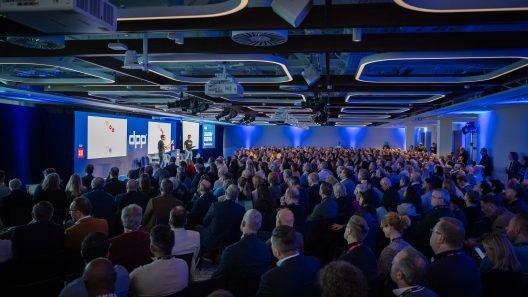
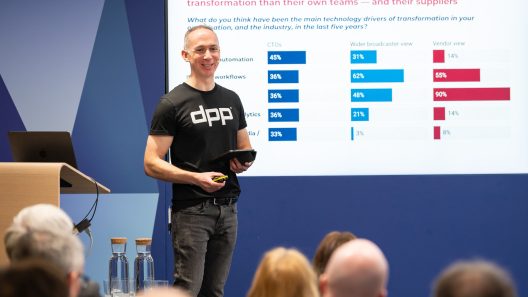
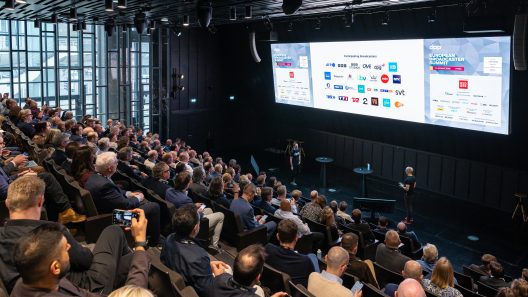
At the DPP European Broadcaster Summit 2026, we specifically asked representatives from 28 major media organisations the extent to which the AI innovations are having an impact on procurement and attitudes to custom development. Fundamentally, how much is AI changing whether those organisations are looking to buy from industry suppliers, or increasingly build and manage their own technology?
Participants at the event, from both content providers and media tech suppliers, overwhelmingly responded that AI assisted development tools have increased their internal capacity to write code.
More than 80% of those participants in March 2026 responded that AI-assisted development tools have provided a significant (45%) or moderate (37%) increase in their internal capacity to write code.
But has much changed because of these capabilities?
To a certain extent, yes. And it's worth emphasising that many European media companies participating at the European Broadcaster Summit in Paris said that this is an area they are actively exploring.

The chart above presents the responses from 28 European media companies, as well as the perception of 96 industry vendors and services providers. And while the majority of media organisations responded that so far there has been no change in their approach, more than a quarter have already shifted their position.
Some 11% of European broadcasters said their strategy had undergone a 'shift to build', and a further 11% responded their approach was to buy the core platform but build the custom 'glue' and extensions in-house. Another 4% are looking to buy while using AI (at least where they can) to more heavily customise off-the-shelf tools.
One broadcaster participant reported they are moving aggressively towards AI-enabled builds:
"We are heavily into moving into build, with AI enabling that. Our product team has a target that within a year AI will do all the coding for us. I'm expecting that to happen, or at least that we will be close."
Another, commenting on how AI was impacting its technology and business strategy, suggested this change was coming.
"We tried for years, or decades, to do less development in house. But it could be that these new tools give us the opportunity to shift minds," they said. "That really would be a significant or complete change in our overall strategy."
At the DPP Media Supply Festival 2026 in New York, Director of Content Supply Chain Technology for DPG Media, Ygor Geurts, discussed the organisation's experience of moving from a five-week "Moonshot", through a turning point, to being AI-first.
While the broadcaster had an established culture which tended towards building tools themselves, "now the shift has gone considerably more to build".
"We redesigned our codebase and architecture to be Agent-first," Geurts says.
The perception and attitude of vendors is worth noting here. Their views in the chart above suggest a significant concern among the supplier community about this shift.
And in a presentation at the DPP European Broadcaster Summit 2026, Aaron Nuytemans from Cuez said he believes there will be the "return of self build" by media companies.
"There will be a return to self-build which means fewer, better vendors. Those left standing in five years will have earned it."
Aaron Nuytemans, Cuez
Although other suppliers sense broadcasters are being somewhat naive about the underlying expertise and maintenance required to execute a 'Build' strategy.
This view was echoed by SDVI's Geoff Stedman in a recent segment on the DPP Podcast [at 15min 55sec].
"Just building a piece of software to do a function may not necessarily get you a product that has the kind of support that vendors bring to the table," he said. "Often you hear customers saying 'while now we got these new AI coding tools we can go build it ourselves'. Ok you can, but now you have got to maintain it, and the person who wrote it has to stick around. There's more to productizing software than just writing code, and that's what vendors are experts at."
'Post-functional technology'
In David Thompson's conclusion to the DPP's most recent Demand vs Supply report — where the DPP Technology Strategist assesses industry forces and maturity in key areas of the media technology ecosystem — this dynamic was described as 'the post-functional world'.
A new paradox is at play, David explains: since AI can be used to create any kind of functionality, the 'arms race' of creating features matters far less, pushing the industry back toward a more human-centric way of working where trust, alignment and interoperability are more meaningful.
"In a post-functional world, differentiation does not disappear but it does shift away from feature sets as customers will be more focused on building the right operating models around them," David says. "The result is an industry that is becoming more dependent on trust at precisely the moment when trust is harder to establish."
This interplay will continue to shape the industry's direction. And we will next explore the impact of AI coding at upcoming DPP events in Amsterdam and London, where the implications of 'Buy vs Build' and post-functional technology will be discussed.