






Photo: Craig Jordan-Baker
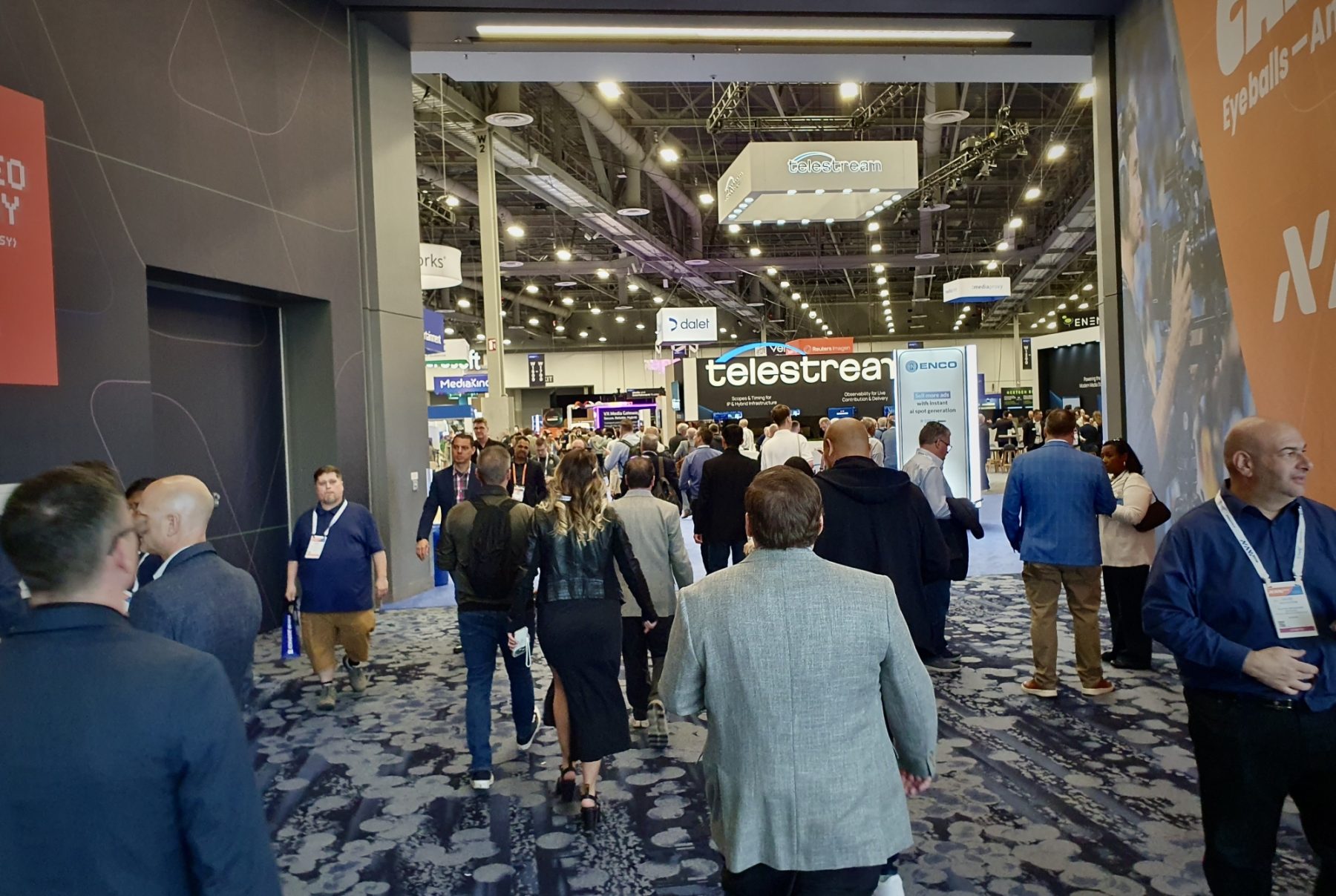
Based on the conversations with the many contributors to this report at the Las Vegas Convention Center, the overall impression was that NAB in 2026 felt significantly quieter and more subdued than in previous years. This tallied with our own observations while walking around the show floors.
NAB in 2026 felt significantly quieter than previous years
Footfall often appeared uneven throughout the day, with pronounced peaks and troughs. A particularly slow start on Sunday was followed by a spike on Monday, and a noticeable drop-off on Tuesday. The peaks and troughs seen on the show floor at NAB are also reflective of the fact that a large number of attendees are no longer coming for the full show. Many of our contributors, particularly from North America, only attended NAB for a day, booking key meetings accordingly and not walking much around the show floor.
While exhibitors emphasised the quality of conversations with their customers in pre-booked meetings, the majority we spoke with reported fewer badge scans and visitors to their booths. The West Hall in particular felt less crowded than the North and Central halls, which were filled with more tangible production, post-production, and creator technologies.
Yet, these observations are at odds with the official figures released by NAB, which reported 58,000 attendees at the 2026 show – up 5% from 55,000 in 2025. We are left wondering: is general attendance any longer a reliable signal for measuring the quality and value of engagement at trade shows?
Attendance statistics don’t necessarily equate to quality engagement
In addition to a perceived decrease in traffic, the exhibition space at NAB 2026 felt much less dense, with wider aisles between booths and more open space at the back and side of the halls screened off or filled with tables and chairs and food vendors. One contributor even reported playing football (soccer) with other exhibitors in one of the aisles in the West Hall during a particularly quiet period.
Again, this is at odds with official NAB statistics which state that there were 1100 exhibitors at this year’s show, a slight increase on the 1,050 who exhibited in 2025. The perceptual disparity may be a result of the changing NAB Show floorplan which now occupies the West, North, and newly renovated Central Hall. Another reason may be that some vendors who traditionally have taken larger booths opted for a smaller presence this year.
Such mixed signals warrant closer scrutiny on the official figures, to try to achieve a better understanding of the underlying dynamics.
NAB reported once again that nearly half of the people present were first time NAB attendees. This continues a trend which has been reported the past three years.

This helps us to understand what’s really going on:
- There is a core contingent of repeat visitors – appearing relatively static in a range between 26,000 and 30,000.
- There has been a large, and persistent influx of new attendees.
- But total numbers are not going up – so there is high churn. In other words, most of those new visitors are balanced by visitors choosing not to return.
NAB attendance statistics imply high levels of churn
Unfortunately, this data doesn’t offer a full understanding of who makes up either the repeat or first time visitor cohorts. We are also unable to discern whether it is the first timers or long term NAB attendees who are churning.
One exhibitor also reported that their scan data revealed that a significant number of attendees had registered with Gmail as opposed to corporate email accounts.
We can, however, use some reverse engineering to gain a limited understanding of some of the statistics provided by NAB.
- In 2026, NAB reported that 13,000 attendees were corporate or enterprise media media professionals - nearly double the 2025 number.
- In 2026, the NAB show had a 140% increase in content creators over 2025.
This information points to an ongoing structural shift in the audience for NAB – with significant growth in enterprise and corporate video use cases, and an expansion in representation from the creator economy. Conversely, analysing these numbers against the repeat NAB Show visitor core, we can determine that there is a significant dilution in the traditional broadcast and M&E presence at the show.
The implication is significant, indicating that the density of M&E buyers and decision-makers on the show floor is most likely declining. And this aligns with exhibitor feedback we received in terms of fewer booth visitors, and a lower perceived return on investment. Creators in particular are mostly only viable buyers for cameras, NLEs, and lower-cost production equipment, which represent a modest proportion of exhibitors.
There is a significant dilution in the traditional broadcast and M&E presence
Due to geopolitical considerations, the expectation was that international participation in NAB would drop in 2026. NAB reported that 22% of visitors at this year’s show came from outside the United States – indeed a drop from previous years.

A drop of 11% was lower than forecast by many. Yet a huge majority of our contributors reported a sharp decline in meetings with international customers, particularly from Europe and Latin America. One global vendor contributor reported that they had only 6 meetings with international clients, and that they now view NAB as a regional trade show.
Contributors reported a sharp decline in meetings with international customers
Given that NAB’s data indicates there were 343 non-US companies exhibiting, plus some non-US individuals attending on behalf of US-registered companies, we can assume that the number of international customer attendees is notably lower than the total number of international attendees.
Finally, NAB reported that of the 1100 vendors who exhibited at the NAB Show in 2026, that 132 were first timers. The chart below plots first time exhibitors vs returning exhibitors over the past 3 years.

This shows another contradiction: despite some vendors telling us that they were planning to not exhibit again at the NAB Show, the rate of return was actually very strong. The highest attrition rate happened between 2024 and 2025, with over 250 vendors – 19% – choosing not to exhibit again.But this year just 93 vendors chose not to return, with a slight increase overall of almost 5% in the number of exhibitors.
The perception of empty exhibition space is not reflective of fewer vendors exhibiting
So although some vendors opted for smaller booths, the perception of less filled exhibition space this year is not reflective of fewer vendors exhibiting at the show.
A Comparative Analysis
In our Demand vs Supply reports, the DPP provides a comparative view of the major industry trade shows, tracking attendance and exhibitor numbers at NAB and IBC since their pre-pandemic peaks in 2017. Since the IBC 2025 report – which focused on AV Broadcast – we have also included comparisons with ISE, the largest major ProAV industry show.
With another year of data, the evolving industry dynamics are becoming somewhat clearer – even as the lessons learned become more complex.

It is clear that ISE has continued its sustained growth, being the only large trade show to demonstrate both sustained growth over the past five years and to have exceeded its pre-pandemic attendance rates. With NAB now also posting a modest 5% uptick in attendance, we look forward to Amsterdam in September to see if IBC also reverses its decline from 2025.
NAB 2026 posted a modest 5% rise in attendance

Exhibitor numbers reflect a similar pattern. NAB and IBC have both posted overall declines since 2024, with NAB rebounding just slightly this year. Once again ISE is the only show to have grown since the pandemic.
Growth in the enterprise
In February 2026, the DPP attended ISE, where a number of DPP members and contributors were present – many for the first time. This reflects a growing recognition of the relevance of the ProAV sector to media and entertainment vendors, and even the convergence of ProAV and traditional media production.

Photo: James Dade | ISE 2026 Hall 3
ISE has a unique momentum, reflecting the fact that it serves a wider range of industries including corporate, education, government, religious, and live events. These are sectors where demand for content creation and distribution is expanding at a rapid rate.
The ProAV sector is becoming increasingly relevant to media and entertainment
It is no wonder that this growth has led to increased attention on the ProAV market from the established media sector. NAB reported a doubling in its attendance from the enterprise and corporate sector in 2026. And, as we saw in the DPP’s IBC 2025 Demand vs Supply Report, IBC has also been courting the enterprise sector via partnerships with the AV User Group to bring traditional broadcast vendors and AV users together. Interestingly, ISE has also approached this from the other direction offering tours at its 2026 show to representatives from a number of European public broadcasters.
NAB and IBC have been central to the media industry for decades. However, in the midst of the current market turbulence and change, they are having to work hard to better understand what matters most to attendees and exhibitors. Travelling to trade shows is a significant investment of time and money. In the current industry and economic climate, many companies are thinking hard about how to balance broad visibility with more targeted engagement.
Sheer scale no longer completely delivers on expectations
The key conclusion to be made is that the link between overall attendance to engagement value no longer holds firm. The sheer scale of the larger trade shows is no longer the most important way to deliver on attendee and exhibitor expectations. Impressions based on what the show floor actually feels like, and the quality of conversations between attendees, are much more impactful than official statistics.