





Since peaking in 2017, attendance at the two largest broadcast trade shows, IBC and NAB, has declined. While two years of cancellations during the pandemic hastened this contraction, a modest bounce back has been followed by a further reduction in visitor numbers at both shows.
A variety of explanations have been offered for this. Travel and promotion budgets are tighter due to reduced margins. Virtual collaboration tools have reduced the need for physical presence. And as software and cloud services displace hardware, technology itself has become less tangible — there are fewer things to see and touch on a stand. And while all this is true, it may not be the full story.
IBC, NAB and ISE Attendance (2017 - 2026)

Beyond the traditional broadcast shows, a different trajectory is being established. Integrated Systems Europe (ISE), the world’s largest professional AV exhibition, has been expanding with notable momentum. In 2024 its attendance exceeded that of NAB, and it has continued to climb. Counter to the narrative of the trade show decline, ISE has broadened its scope, diversified its audience, and attracted new investment from partners and exhibitors.

In 2025, while exhibitor numbers went down at both NAB and IBC, they continued to grow at ISE. Vendors have not withdrawn from trade shows altogether, they are reassessing their presence based on perceptions of where growth and innovation are happening.
It was against this backdrop that I began looking more closely at what is increasingly referred to as Broadcast AV as part of the DPP’s IBC 2025 Demand vs Supply report.
Broadcast AV is what happens when enterprises such as financial services, global corporations, government agencies, NGOs, houses of worship, and event venues create and publish content. It encompasses live and pre-recorded production, post-production, content management, archiving, distribution, engagement, and marketing. Technically, it spans a wide spectrum from cameras, lighting rigs, automated control rooms and broadcast-grade graphics engines to everyday communications tools such as Zoom and Microsoft Teams.
It cannot be dismissed as ‘corporate video with expensive kit’, or as a simplified ‘broadcasting for idiots’. It is the application of professional broadcast quality in environments where storytelling carries commercial, political or institutional weight equal to that of traditional media.
And, the market dynamics are key to understanding its success. While traditional broadcast markets are shrinking, the Broadcast AV market is growing.

Data from AVIXA shows that the Broadcast AV market now accounts for over $44.2 billion in annual revenue (AVIXA 2025 IOTA forecast for ProAV Revenue).
It has overtaken Digital Signage ($42 billion) and now sits second only to Conference and Collaboration ($61 billion) within the overall ProAV space.
The most obvious interest in Broadcast AV is of course from traditional media technology vendors who are seeking to grow in new markets as growth stalls in their traditional base. But they’re not the only group who have awakened to new potential in this space. Production companies and even some broadcasters are also bidding for corporate work and competing to deliver live productions for brand experiences.
What may not yet be intuitively obvious is the fact that the flow of ideas and technologies between industries is very much bi-directional. It is easy for those steeped in broadcasting to assume that their decades of heritage mean that they define the benchmark and the upstart Broadcast AV sector can learn from them. But the reality is that the AV sector can teach broadcast just as much as it can learn.
Control systems provide one example. AV integrators have developed highly intuitive, flexible control room environments designed around operators rather than engineers – and these are now being purchased by broadcasters.
Enterprise meeting platforms are rapidly incorporating production values once confined to TV studios: real-time graphics, virtual sets, XR layers and augmented reality integration. Some of these developments are then being deployed back in broadcasting – in news, sports, and unscripted entertainment.
The AV sector has also embraced IP video at a far faster rate than established media. While broadcast has been debating and overengineering IP transport, AV has gone ahead and implemented it. This is playing a role in democratising the production and broadcast of new, and more niche content.
At the same time, AV has not compromised on reliability. Banks, multinational corporations, governments and large institutions require signal integrity, redundancy and professional standards just as national broadcasters do. In many cases, the financial or reputational stakes are comparable, if not higher.
This convergence is reshaping production models as much as technology. Lean teams, app style creative tools, and remote collaboration are normalised. High production value no longer implies fixed infrastructure or large crews. While the creator economy demonstrated the viability of lighter production models, it is Broadcast AV that is running them at an institutional scale.
For content companies this is both uncomfortable and liberating. It challenges inherited assumptions about ‘the right way to do things’. But it also opens new routes to growth.
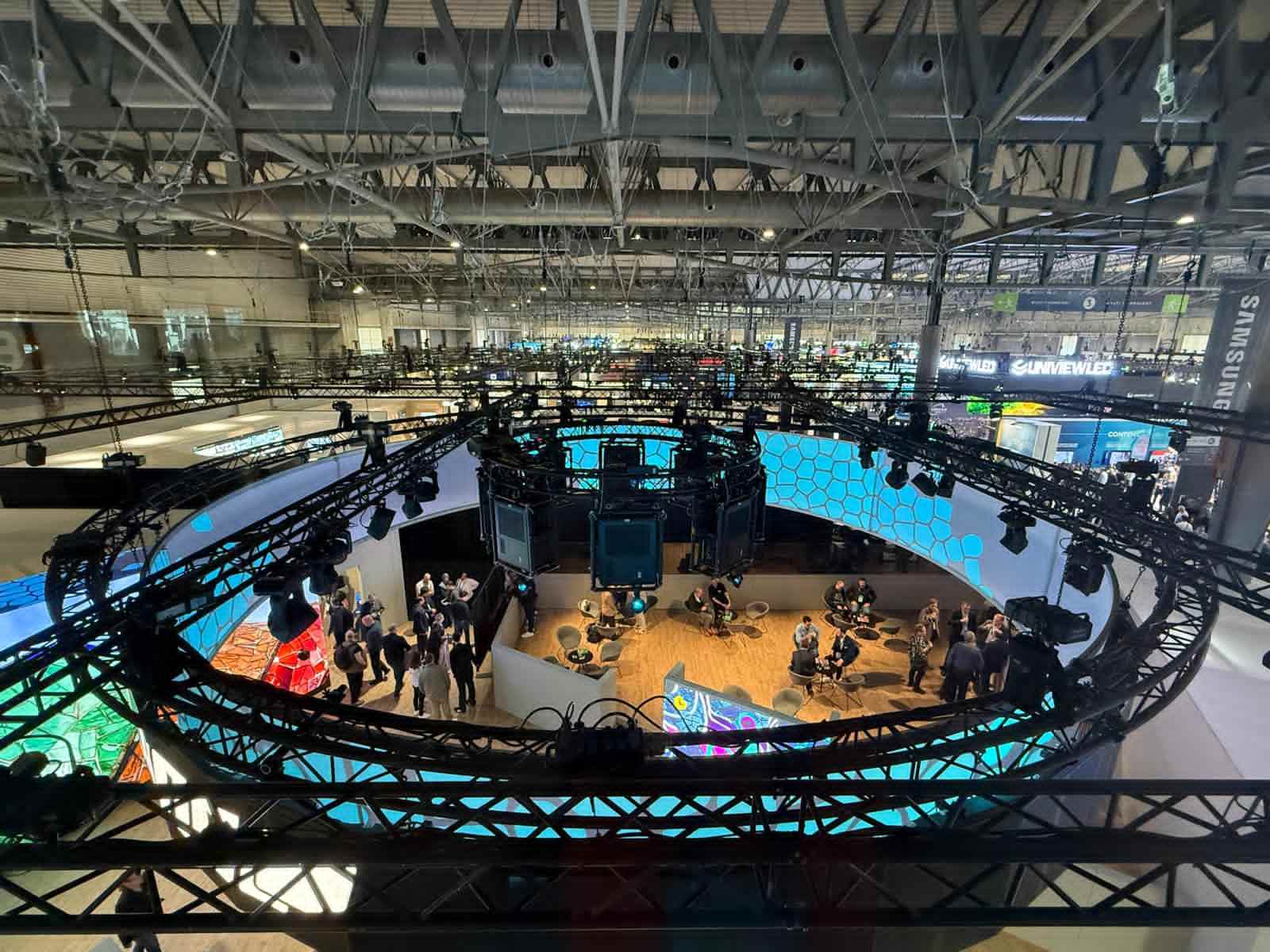
Attending ISE for the first time reinforced this impression of momentum.
The contrast was not just about footfall. It was about purpose and confidence. Exhibitions were more solution-led; framed around outcomes rather than process or specifications. Demonstrations were immersive and user centric. Non-traditional environments and public spaces were used to construct narratives. The canvas was broader and not limited to the standard consumer devices.
Another notable difference was the emphasis on training and professionalisation. AVIXA continues to expand and develop its recognised CTS training and qualification programme. Vendors and Integrators such as Netgear and Diversified are investing in structured education programmes to elevate technical competence among their customers. These are signs of an industry actively pushing to develop its maturity. This is also something lacking at broadcast conferences, which don’t have as much to offer to their less senior attendees.
For the media and entertainment industry, Broadcast AV should not be viewed as merely an adjacent opportunity. It is an opportunity to rethink how we work
Broadcast still has significant strengths: storytelling, editorial discipline, reliability engineering, and creative ambition. These remain core differentiators. But there is equal value in learning from AV’s pragmatism, user-centric design, and willingness to simplify without cutting corners.
The question is whether broadcasters are prepared to evolve their operating models and cultural assumptions to take advantage of this new growth market. It may be that we will soon reach the point where they no longer have the choice if they wish to remain competitive.